Services / Automation
Automation
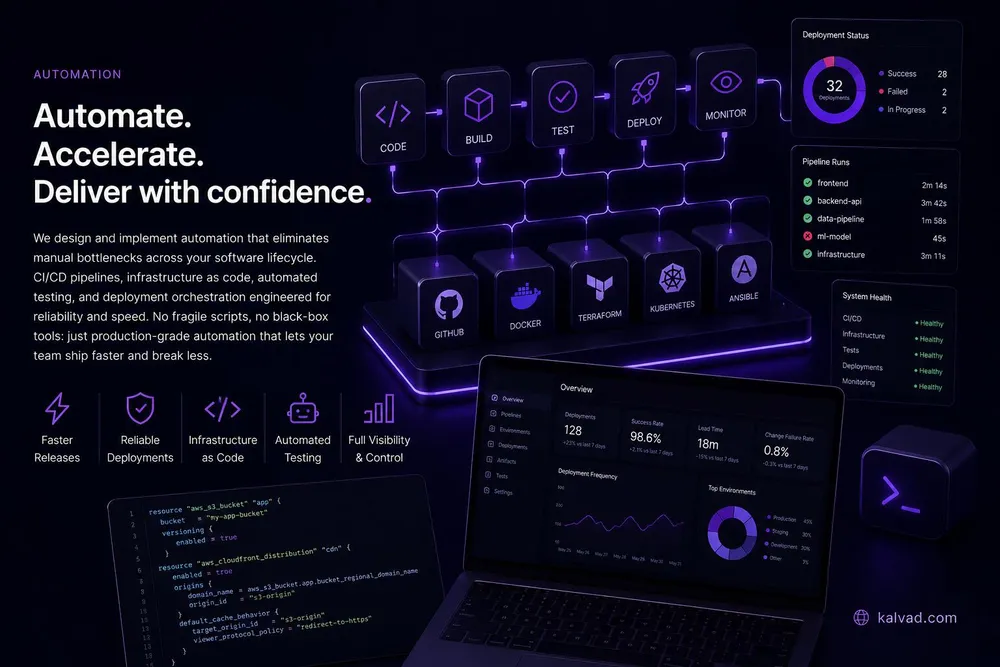
We design and implement automation that eliminates manual bottlenecks across your software lifecycle. CI/CD pipelines, infrastructure as code, automated testing, and deployment orchestration engineered for reliability and speed. No fragile scripts, no black-box tools: just production-grade automation that lets your team ship faster and break less.

Problems We Solve
Automation projects fail from over-engineering and poor maintenance, not from lack of tools. Below are the situations we encounter most often.
Manual deployments that break under pressure
Someone runs a script from their laptop, forgets a step, and production is down. We replace manual deployments with automated pipelines: build, test, deploy, verify. Every deployment is repeatable, auditable, and reversible. No more tribal knowledge or deployment checklists.
CI/CD pipelines that are slow and fragile
Tests take 45 minutes. Builds fail randomly. Nobody trusts the pipeline so they deploy manually anyway. We optimize pipelines for speed and reliability: parallel test execution, caching, flaky test isolation, and clear failure messages. A pipeline should give fast feedback, not slow the team down.
Infrastructure drift from manual changes
A server is patched by hand, a config file is edited directly, and the environment no longer matches the code that describes it. We implement infrastructure as code so every change is version-controlled, reviewed, and reproducible. Manual changes are for debugging, not operations.
Testing bottlenecks that delay releases
Tests are an afterthought, run manually before release, or skipped entirely when deadlines loom. We integrate automated testing into the pipeline: unit tests on every commit, integration tests on every merge, and end-to-end tests on every deploy. Testing is part of the process, not a gate at the end.
What We Deliver
Concrete automation services, not vague promises.
CI/CD pipeline engineering
Build, test, and deploy pipelines that are fast, reliable, and observable. From simple workflows to complex multi-environment orchestration.
Infrastructure as code
Terraform, Ansible, and custom tooling. Every server, network, and configuration defined in code and version-controlled.
Automated testing & QA
Unit, integration, and end-to-end tests integrated into the pipeline. Tests that catch regressions, not slow down development.
Deployment orchestration
Blue-green, canary, and rolling deployments. Automated rollbacks and health checks. Deployments that are boring, not exciting.
Our Approach
Automation is not about replacing people, it is about removing friction. We start by understanding your current workflow, identifying the highest-friction processes, and automating incrementally. Every pipeline is version-controlled, every script is tested, and every automation has a clear path to recovery when things go wrong.
Pipeline audit & assessment
Architecture design
Incremental automation
Production rollout
Monitoring & alerting
Documentation & runbooks
Why Work With Kalvad?

Engineering-first, not tool-first
Deep experience with CI/CD, IaC, and deployment automation
Tool-agnostic: we choose what fits your workflow
Incremental automation, not big-bang rewrites
Long-term maintainability over clever scripts
Open-source first: we build on and contribute to open-source tools
Want to understand our engineering philosophy? Learn more about why we do things differently.
Related Blog Posts

Why We Chose Woodpecker CI (And You Probably Should Too)
While everyone argues about GitHub Actions and GitLab CI, we quietly run Woodpecker CI. Here is why it became our default for self-hosted pipelines.

Compliance Standards Are Not Carved in Stone, Stop Treating Them Like They Are: A 2026 Field Report
Your compliance standards are not carved in stone, your competitors are not waiting for your next change board meeting, and your security team has 18 months to pick a side. A 2026 field report from a conversation that should never have happened.
Security is a never-ending process, not a validation step! (2026 edition)
Four years later, half of what I wrote is embarrassing. The other half is still true. Your WAF is still useless, your SIEM still spams your on-call, and your security team still cannot code. Let's fix all of that.

From Mic Blip to Wiki Page: Meet Hubert, Our Self-Writing Meeting Machine
Meet Hubert, our self-writing meeting machine, inspired by the legendary OSS 117. Like Hubert Bonisseur de la Bath, it navigates chaos with effortless charm, turning audio into structured notes. No buttons, no fuss. Just results, delivered with the panache of Jean Dujardin’s iconic wink.
Related Product
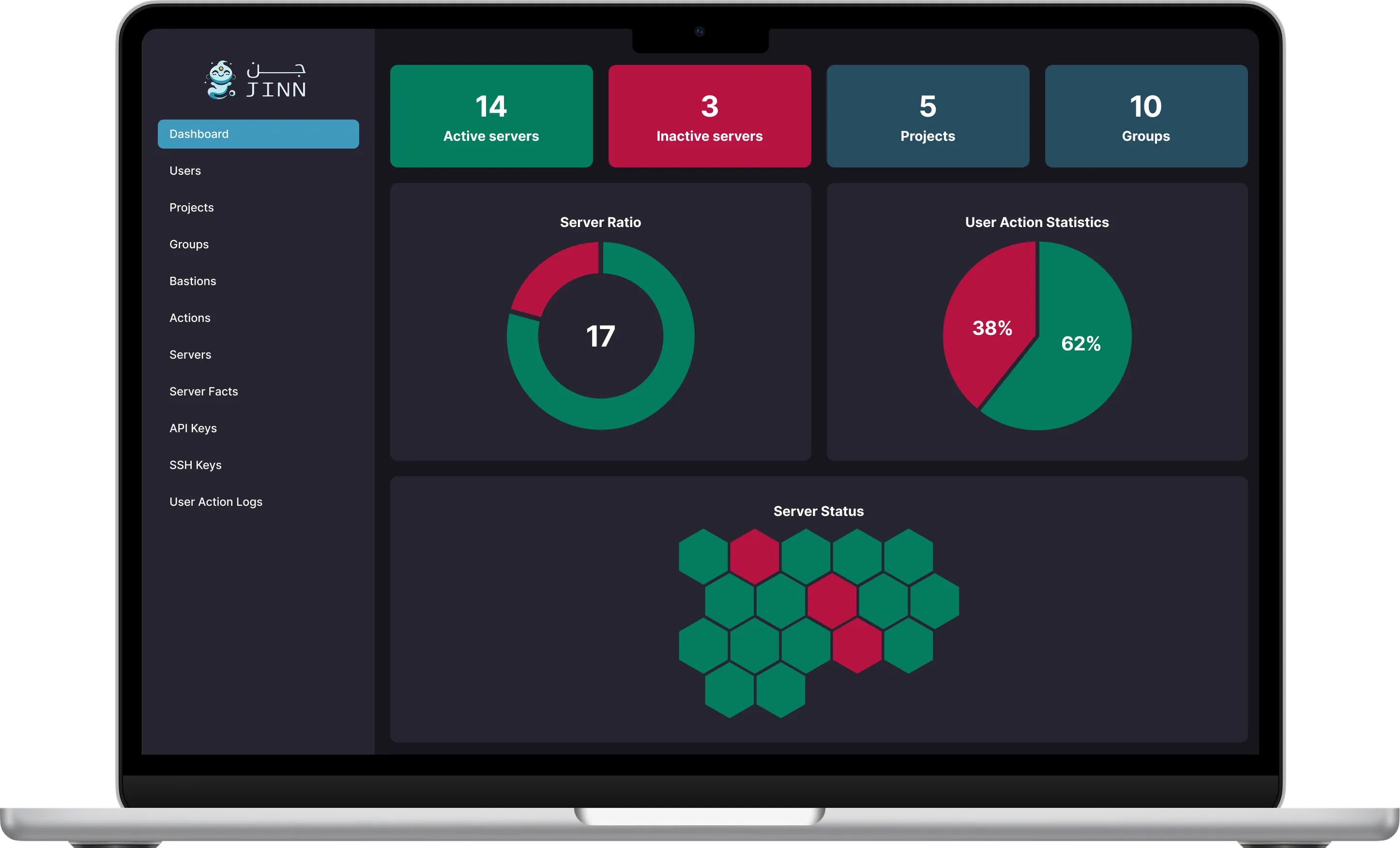
Jinn
Automated Server Security & Vulnerability Patching Platform
Trusted by 500+ enterprises across the gulf region & beyond
Related Guide
On-Premise Production
Learn why leading organizations are bringing infrastructure back in-house: cost control, data sovereignty, and operational excellence without vendor lock-in. Real-world patterns from production deployments.
Frequently Asked Questions
Which CI/CD tool should we use?
It depends on your hosting preference, team size, and existing tooling. GitHub Actions and GitLab CI are popular and well-supported. Woodpecker CI is lightweight and self-hostable. Jenkins is flexible but requires more maintenance. We evaluate your requirements and recommend the tool that fits your workflow, not the one that is most trendy. We also migrate between tools when the current one is holding your team back.
Should we automate everything at once?
No. Automation should be incremental. We start with the highest-impact, highest-friction processes: deployments, testing, and environment provisioning. Once those are stable, we expand to areas like database migrations, certificate management, and incident response. Automating too much too quickly creates brittle pipelines that are harder to maintain than the manual processes they replaced.
How do you handle rollbacks when automated deployments fail?
Every automated deployment includes a rollback strategy. This can be as simple as reverting to the previous container image, or as complex as running a full DAG execution including restoring backups, reverting database schema, and leveraging PITR. We test rollback procedures as part of the pipeline, not just the forward deploy. The goal is that when something goes wrong, the system recovers automatically or with a single command, not a frantic debugging session.
How long does it take to set up a CI/CD pipeline?
A basic pipeline with build, test, and deploy stages can be set up in a few days. A comprehensive pipeline with multiple environments, approval gates, security scanning, and performance testing typically takes 2 to 4 weeks. The timeline depends on the complexity of your application, the number of environments, and the level of automation you want to achieve.
What happens after the automation is in place?
We document everything: pipeline architecture, configuration, and runbooks for common issues. We can stay on for ongoing maintenance and optimization, or hand over to your team with training sessions. The pipelines we build are designed to be understandable and maintainable by your engineers, not dependent on us.
Let's talk about your automation strategy
Whether you are building CI/CD pipelines, implementing infrastructure as code, or trying to eliminate manual bottlenecks in your workflow, we can help. No sales pitch: just an engineering conversation about your processes, your constraints, and what comes next.
Talk with our engineers