Services / Cybersecurity
Cybersecurity
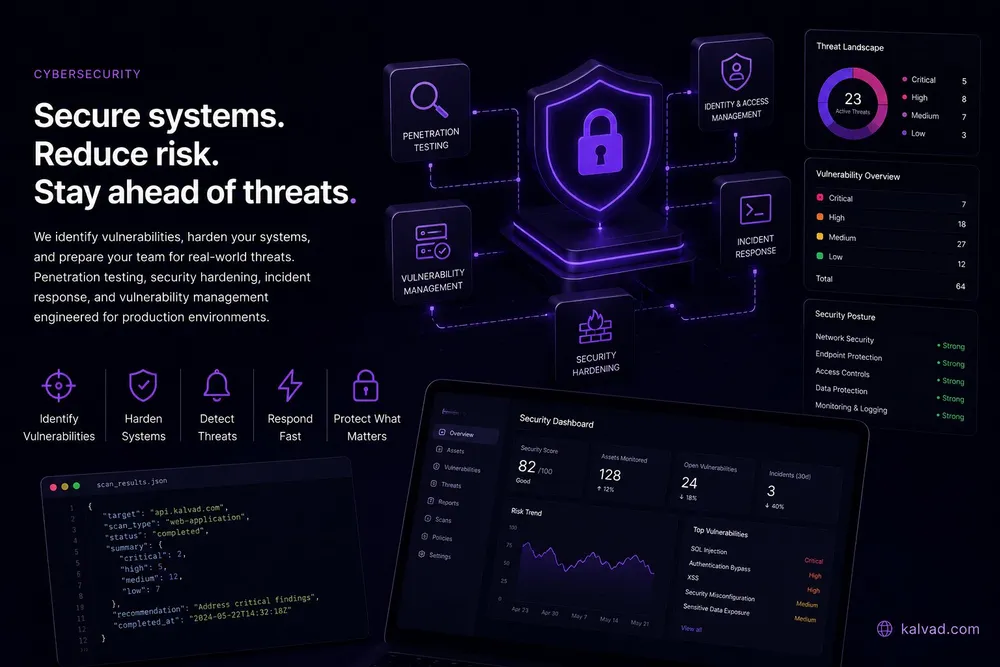
We identify vulnerabilities, harden your systems, and prepare your team for real-world threats. Penetration testing, security hardening, incident response, and vulnerability management engineered for production environments. No fear-mongering, no checkbox exercises: just practical security that protects what matters.

Problems We Solve
Security failures are rarely about lack of tools. They are about lack of preparation. Below are the situations we encounter most often.
Vulnerabilities discovered too late
A security researcher finds your exposed database. A competitor finds your leaked API key. An attacker finds your unpatched server. We identify vulnerabilities before they are exploited: penetration testing, vulnerability scanning, and security assessments that find real problems, not just theoretical risks.
Known vulnerabilities that never get fixed
Scan results that sit unread. Patches that are delayed because nobody owns the process. Critical CVEs that linger for months while the risk compounds. We implement vulnerability management workflows that turn scan results into action: prioritized remediation, automated patch tracking, and accountability that closes the loop.
Incident response without a plan
Something is wrong, but nobody knows who should investigate, who should communicate, or what to do first. Hours are lost while the attacker moves laterally. We help you prepare before an incident: define roles, establish procedures, set up detection, and practice response so your team knows exactly what to do when something happens.
Security tools that create noise, not signal
Hundreds of alerts per day, most of them false positives. A SIEM that nobody looks at. Vulnerability scanners that report thousands of issues with no prioritization. We implement security monitoring that is actionable: alerts that mean something, dashboards that show real risk, and processes that turn noise into decisions.
What We Deliver
Concrete security services, not vague promises.
Penetration testing
Controlled assessments of your systems. Web apps, APIs, infrastructure, and networks. Real vulnerabilities with proof of concept and remediation steps.
Security hardening
Server hardening, network segmentation, access control, and secure configurations. Systems designed to resist attacks from day one.
Incident response
Preparation, detection, containment, and recovery. Response plans that work when seconds matter, not just on paper.
Vulnerability management
Continuous scanning, patch tracking, and remediation workflows. Security that is ongoing, not just point-in-time assessments.
Our Approach
Security is not a product, it is a process. We start by understanding your systems, your data, and your threat model. Every assessment is thorough, every recommendation is actionable, and every defense is designed for the reality of your environment, not a textbook scenario. We prepare you for incidents before they happen, not after.
Threat modeling
Vulnerability assessment
Defense implementation
Monitoring & detection
Incident response
Documentation & runbooks
Why Work With Kalvad?

Engineering-first, not compliance-checkbox-first
Deep experience with Linux, cloud, and application security
Practical defenses, not theoretical frameworks
Incident response preparation before incidents happen
Long-term security posture over quick fixes
Open-source security tools: we use what works, not what is expensive
Want to understand our engineering philosophy? Learn more about why we do things differently.
Related Blog Posts

The AI War Has Begun. And You're Already Conscripted.
On June 13, 2026, the US government blocked Fable 5, firing the first shot in the AI War. At Tech Fest Nancy the day before, François Zaninotto's talk on AI-assisted development sparked the sovereignty debate. If you're still using cloud LLMs without self-hosting, you're already on the losing side.

Compliance Standards Are Not Carved in Stone, Stop Treating Them Like They Are: A 2026 Field Report
Your compliance standards are not carved in stone, your competitors are not waiting for your next change board meeting, and your security team has 18 months to pick a side. A 2026 field report from a conversation that should never have happened.

Security is a never-ending process, not a validation step! (2026 edition)
Four years later, half of what I wrote is embarrassing. The other half is still true. Your WAF is still useless, your SIEM still spams your on-call, and your security team still cannot code. Let's fix all of that.

Introduction to Quantum Cryptography
Quantum cryptography is a new method of cryptography that it’s based on quantum mechanics laws, pretending that uncertainty has the potency to weaken the ability of an intruder to hack or get into a system by boosting the entropy. Relying on the Heisenberg uncertainty principle, we assume that one cannot detect accurately anything depending on this function: A developed quantum cryptosystem (a cryptosystem that will use the roles of quantum mechanics) will maintain a secure system. So now, wh
Related Product
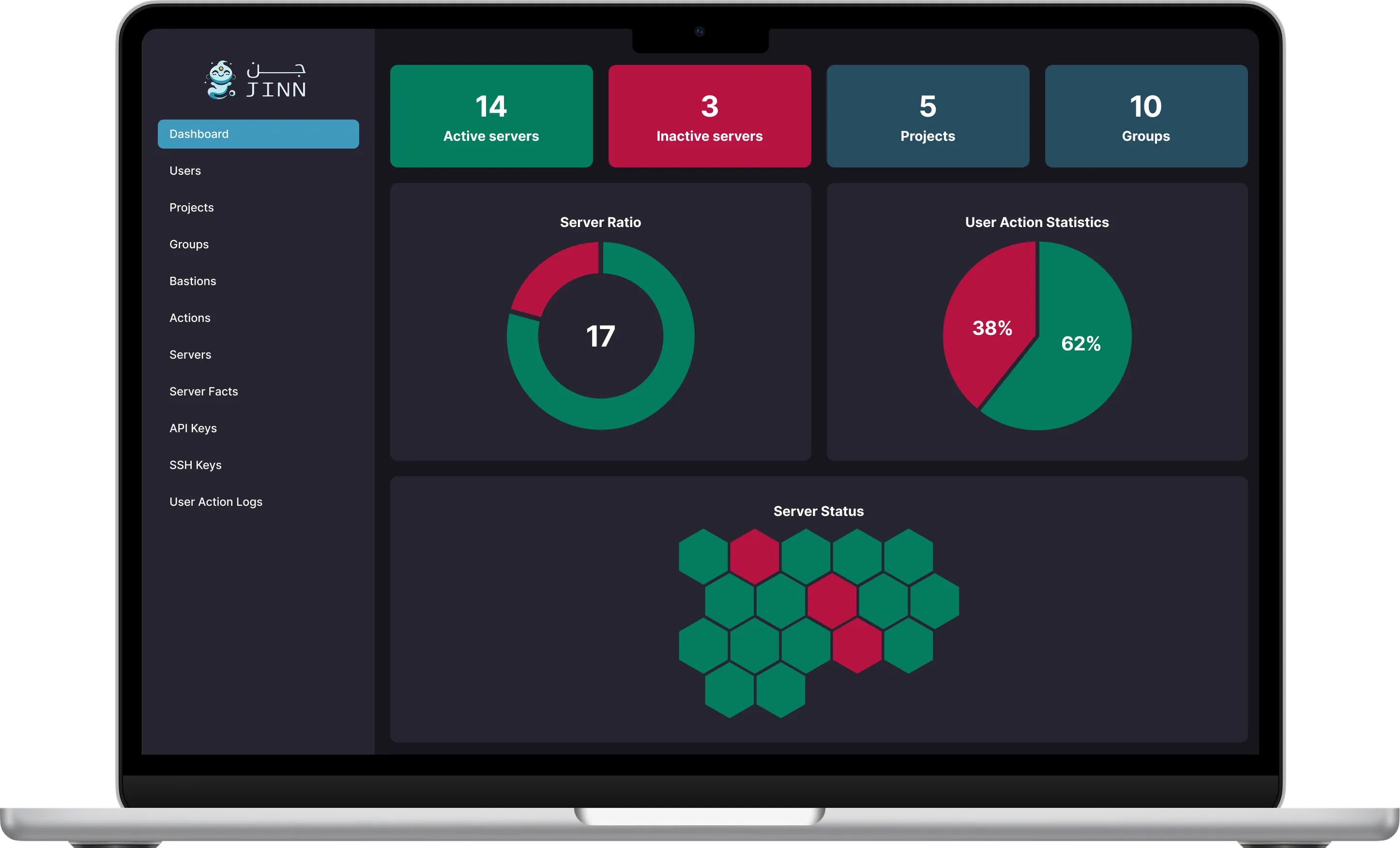
Jinn
Automated Server Security & Vulnerability Patching Platform
Trusted by 500+ enterprises across the gulf region & beyond
Related Guide

On-Premise Production
Learn why leading organizations are bringing infrastructure back in-house: cost control, data sovereignty, and operational excellence without vendor lock-in. Real-world patterns from production deployments.
Frequently Asked Questions
What does a penetration test involve?
A penetration test is a controlled assessment of your systems to identify vulnerabilities that an attacker could exploit. We start by defining the scope: which systems, what level of access, and what rules of engagement. Then we systematically probe for weaknesses: misconfigurations, outdated software, weak authentication, injection flaws, and more. The output is a detailed report with findings ranked by severity, proof of concept for critical issues, and specific remediation steps. We do not just find problems, we help you fix them.
How often should we do security assessments?
At minimum, annually. But the real answer depends on your change velocity. If you deploy weekly, add new services regularly, or handle sensitive data, quarterly assessments make more sense. Any major change, infrastructure migration, or new compliance requirement should trigger a fresh assessment. Security is not a one-time activity, it is a continuous process. We help you establish a cadence that matches your risk profile and operational rhythm.
How do you handle vulnerability management?
Vulnerability management is not just running a scanner. We implement a full workflow: regular scanning of your infrastructure and applications, prioritization based on actual exploitability and business impact, coordinated patching with minimal downtime, and verification that fixes actually work. We track vulnerabilities from discovery to resolution, so nothing slips through the cracks.
What happens if we get breached?
If you have an incident response plan in place, the damage is contained faster and recovery is quicker. We help you prepare before an incident: define roles, establish communication channels, set up monitoring that catches breaches early, and practice response procedures. When an incident occurs, we follow a structured process: contain, investigate, eradicate, recover, and learn. The goal is not just to fix the immediate problem but to make the system more resilient.
Do you provide ongoing security management?
Yes. Security is not a project with an end date. We offer ongoing security management: vulnerability scanning, patch management, log monitoring, incident response readiness, and periodic assessments. We can act as your security team, augment your existing capabilities, or provide periodic reviews. The level of engagement depends on your needs, risk tolerance, and internal resources.
Let's talk about your security posture
Whether you are managing vulnerabilities, responding to a security incident, or building proactive defenses, we can help. No sales pitch: just an engineering conversation about your systems, your risks, and what comes next.
Talk with our engineers